



Playing card identification
Hopefully you’ve found your way here because you’ve identified all the birds and plants in my playing cards set and now you’d like to check your accuracy. You may decide the IN-accuracy in my illustration has thrown you off the scent – I’m more than happy to take the blame and call it artistic license!
If you’re here by accident and meant to find the cards themselves, allow me to redirect you
Clubs: seabirds

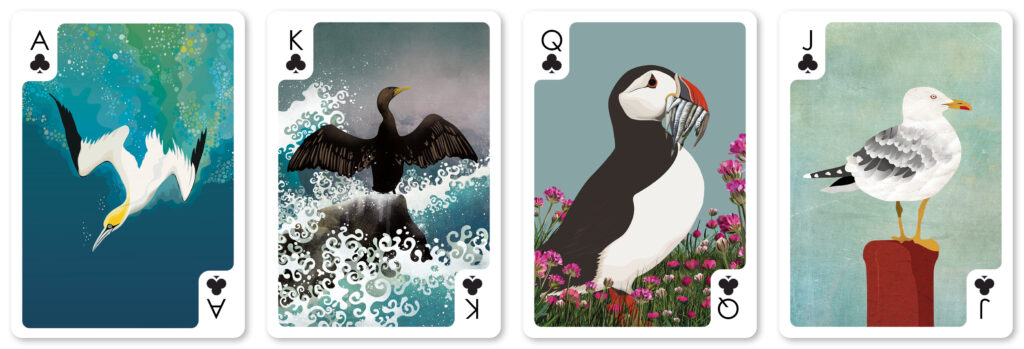
ACE: northern gannet – the largest seabird to be found in the North Atlantic. Their dives are extraordinary – from around 30m in the air, reaching prey up to 14m under water, and hitting speeds of 190km/hr. I recently read that gannets are left or right-winged | KING: cormorant | QUEEN: puffin, with eels in its beak | JACK: gull – this one started as a herring gull but then I drew some wing detail that renders it a bit more like a black-backed gull – you choose!

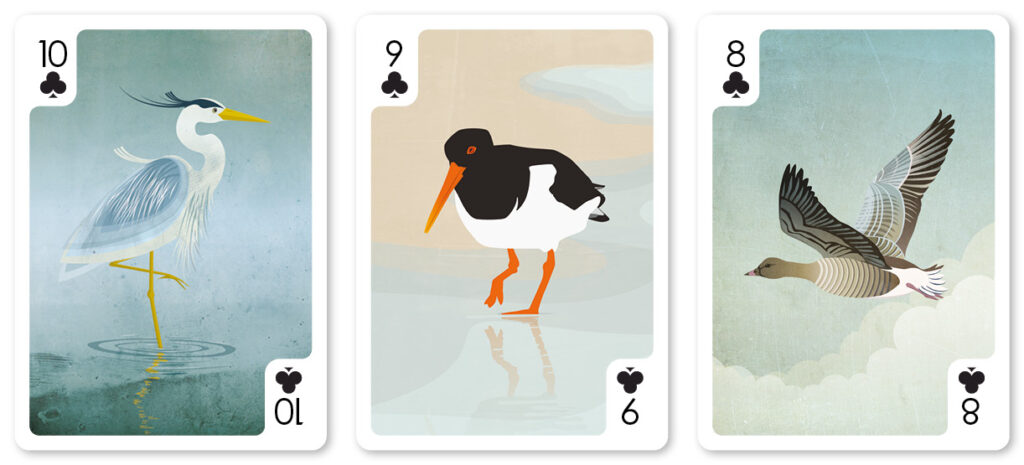
TEN: grey heron – naturally a wetlands wader, there are also plenty of them around our coast line | NINE: oystercatcher – another wader, whose natural habitat is the coast, but I often hear them up in the Lammermuir hills | EIGHT: pink footed goose – pinkies migrate here for our winter, arriving in September and heading back up north in the spring.

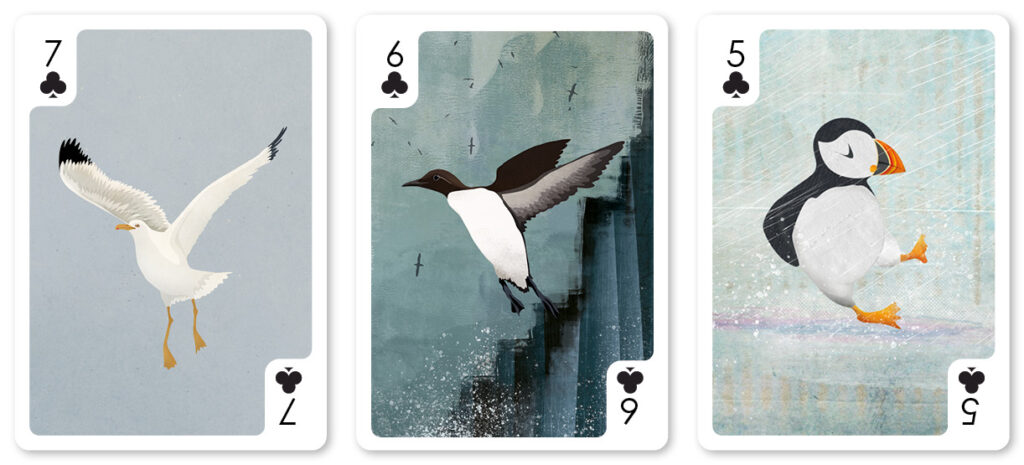
SEVEN: gull – I think we can call this one a herring gull | SIX: guillemot launching itself off the cliffs | FIVE: puffin splashing about.

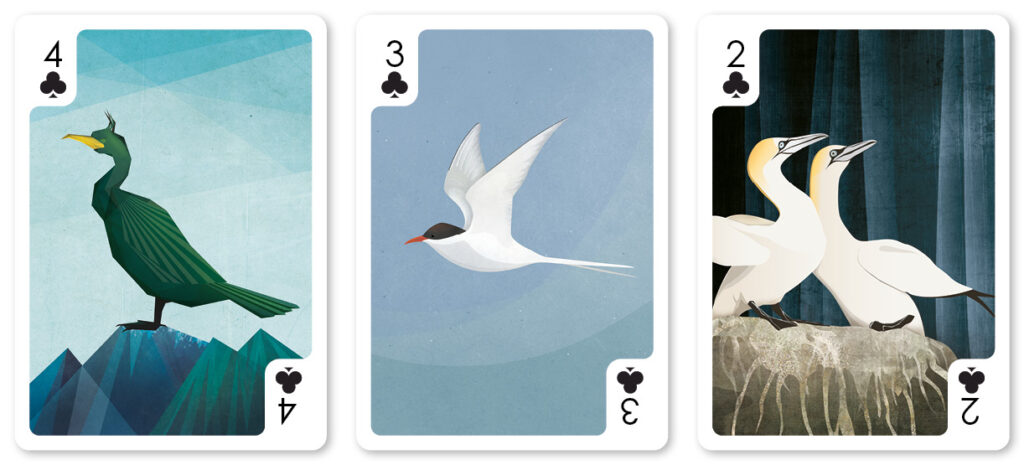
FOUR: shag – which is not, contrary to popular belief (and one of my favourite poems – see the bottom of the page), the common cormorant. We know this one’s a shag because it has green-black plumage (cormorants are more browny), a crest on its head, its eyes sit within feathers above its yellow beak area (cormorants’ eyes sit within the yellow area), and it has an angular face | THREE: arctic tern – I once had to fight one of these for my tray of Alandas chips at Longniddry beach | TWO: a pair of beautiful gannets, demonstrating their tendency to mate for life.
Diamonds: exotic plants

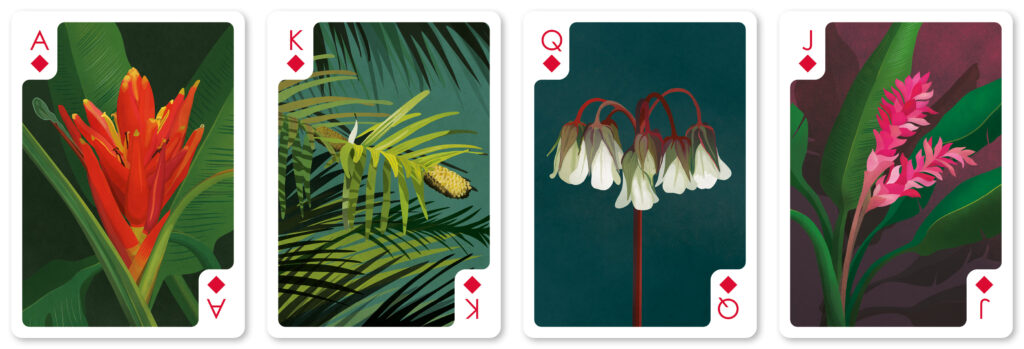
ACE: scarlet banana [musa coccinea] – native to Indochina and considered at risk of extinction | KING: wollemi pine [wollemia nobles] – a coniferous tree endemic to Australia and classified as critically endangered | QUEEN: trichodesma scotti – a shrub from Socotra in Yemen | JACK: red ginger – stunning flower found in the Maluku islands and Pacific islands, but sadly not the delicious root kind.

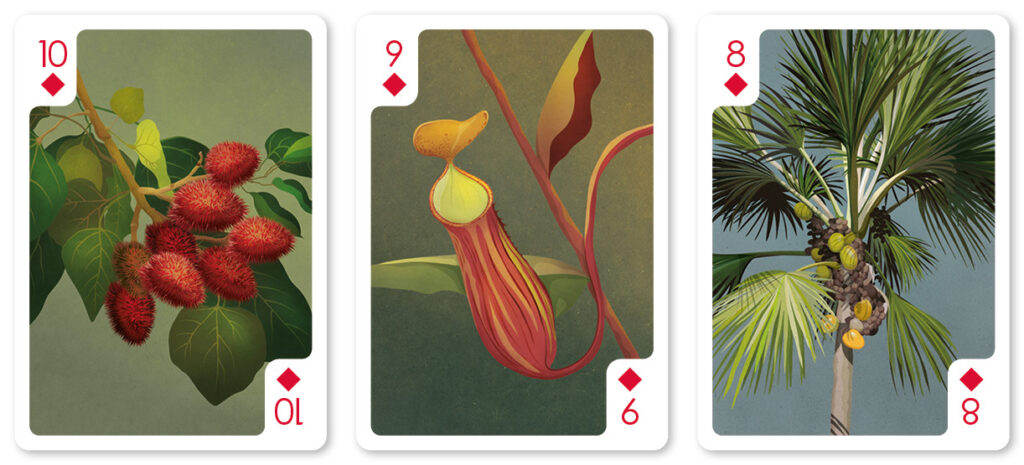
TEN: achiote [bixa orellana] – this is one of my favourite flavours, having grown up eating a Yucatan dish, pollo pibil, frequently. I had no idea what the plant looked like until I drew it for the Botanics. Now it’s also one of my favourite plants aesthetically | NINE: monkey cup [nepenthes ramispina] – a carnivorous pitcher plant native to peninsular Malaysia and considered at risk | EIGHT: coco de mer [lodoicea maldivica] – a palm, native to the Seychelles, with the largest seed in the plant kingdom – at risk.

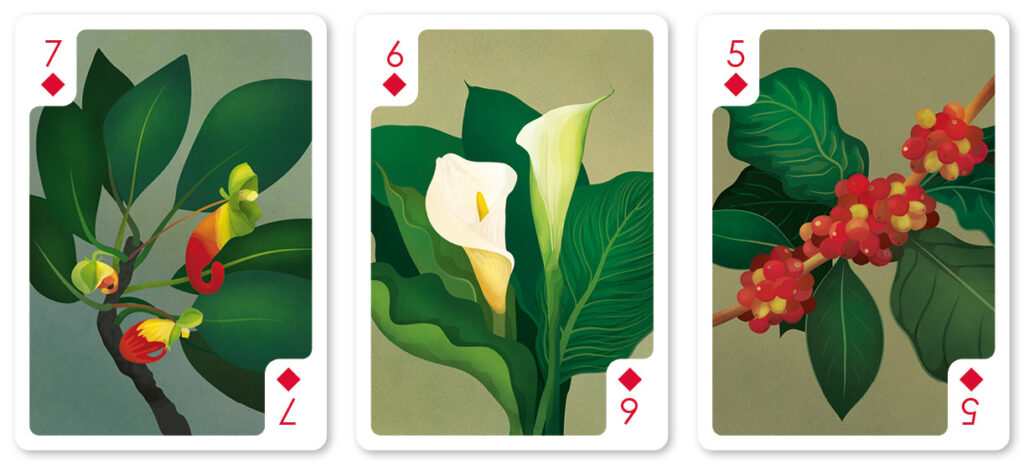
SEVEN: congo cockatoo [impatiens keilii] – Tanzania and Burundi | SIX: calla lily [zantedeschia albomaculata] – Nigeria to Tanzania and South Africa | FIVE: coffee [coffea arabica] – Originally from Ethiopia, it’s now cultivated in many countries, however it’s considered to be at risk because it relies on growing under the cover of forest, so is vulnerable to deforestation. It’s also sensitive to temperature, which doesn’t bode well.

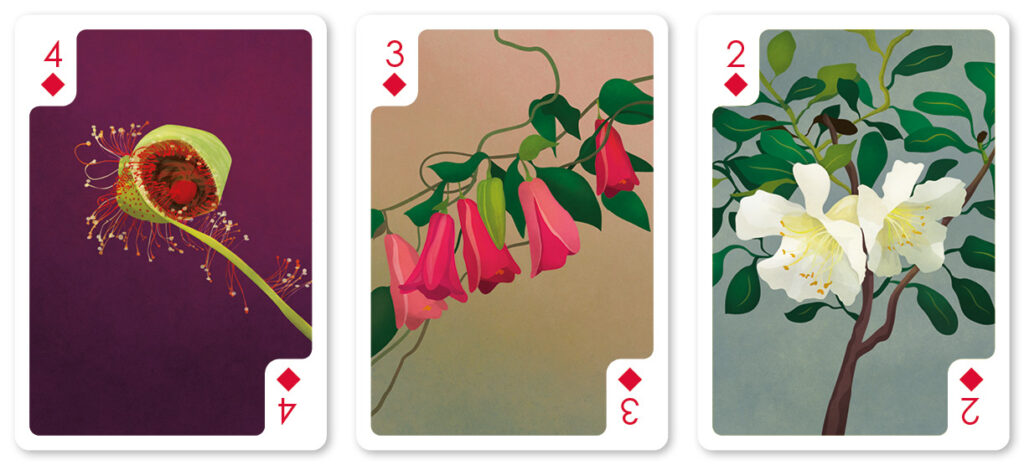
FOUR: cape sundew [drosera capensis] – a fly trap from the Cape region of South Africa | THREE:
chile bellflower [lapageria rosea] – Chile | TWO: rhododendron mendumiae – from the Philippines and at risk.
Hearts: native plants

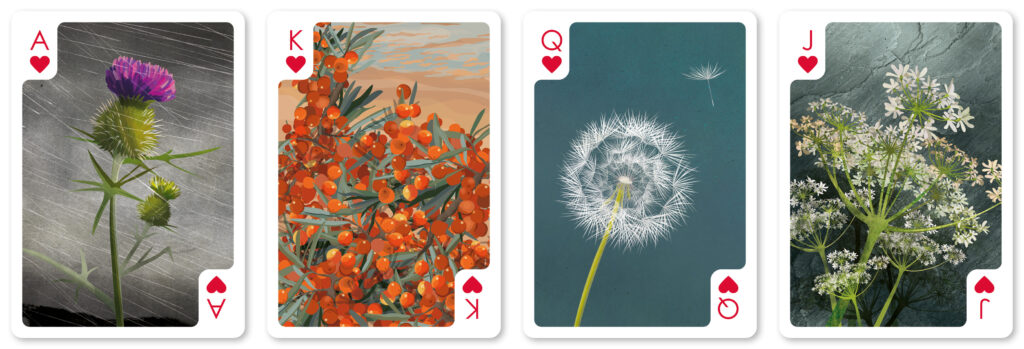
ACE: thistle [onopordum acanthium] in good scottish rain | KING: sea buckthorn [hippophae] – from ancient Greek for ‘horse’ and ‘light’. Full of vitamin C | QUEEN: dandelion [taraxacum] | JACK: cow parsley [anthriscus sylvestris]

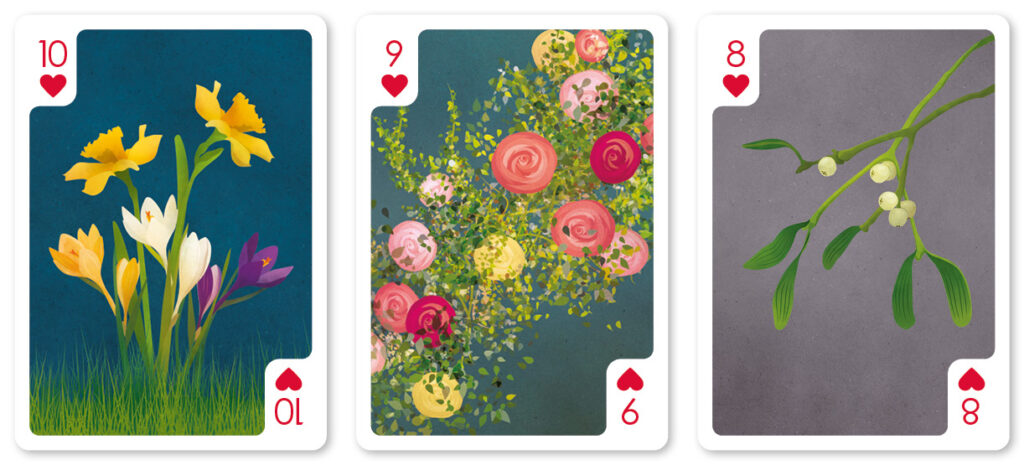
TEN: daffodil [narcissus] and crocus | NINE: rose – this is clearly a spectacular variety which blooms in multiple colours | EIGHT: mistletoe [viscum album] – a rather pretty parasite.

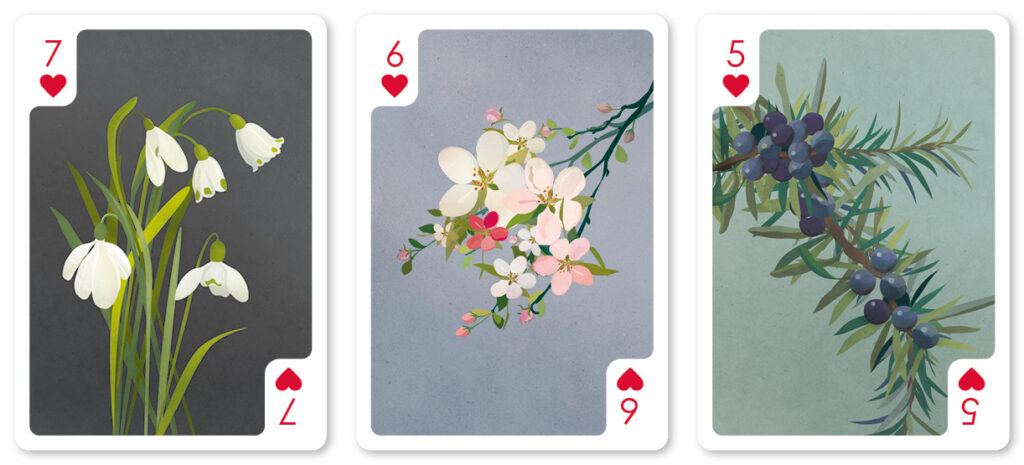
SEVEN: snow drop [galanthus] | SIX: cherry blossom – or, as i now like to call it, having finally made it to Japan, sakura | FIVE: juniper – a coniferous shrub in the cypress family which grows male and female cones on separate plants.

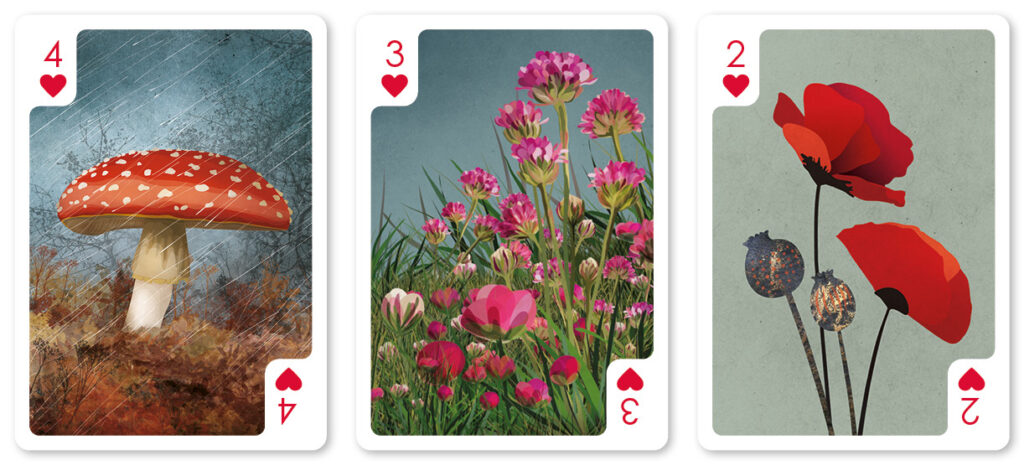
FOUR: fly agaric [amanita muscaria] – stunning toadstool whose name derives from its traditional use as an insecticide | THREE: sea thrift [armeria marítima] – found growing in impossible-looking paces on the coast | TWO: poppy [papaver rhoeas].
Spades: field/garden birds

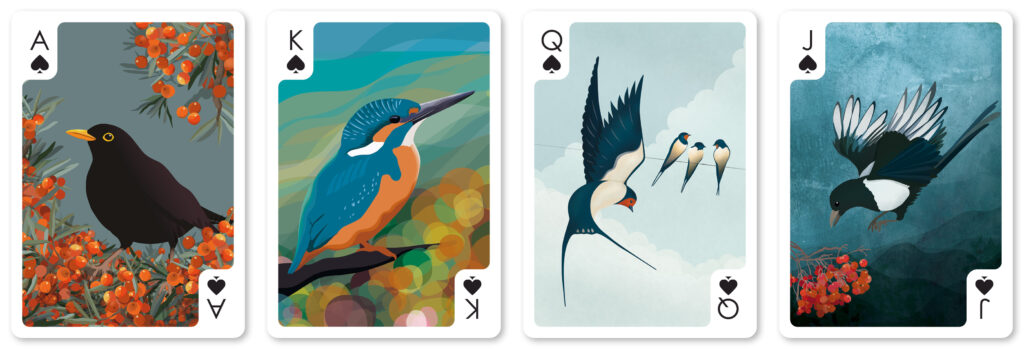
ACE: blackbird | KING: kingfisher (well, he was hardly going to be the jack) | QUEEN: swallow – bringing us joy for the summer and heading back to Africa in Autumn | JACK: magpie – a member of the corvid family, these oft-slandered birds can mimic human speech. And in case your thought process went in this direction, I’ll save you googling: it’s one for sorrow, two for joy, three for a girl, four for a boy, five for silver, six for gold, seven for a secret never to be told.

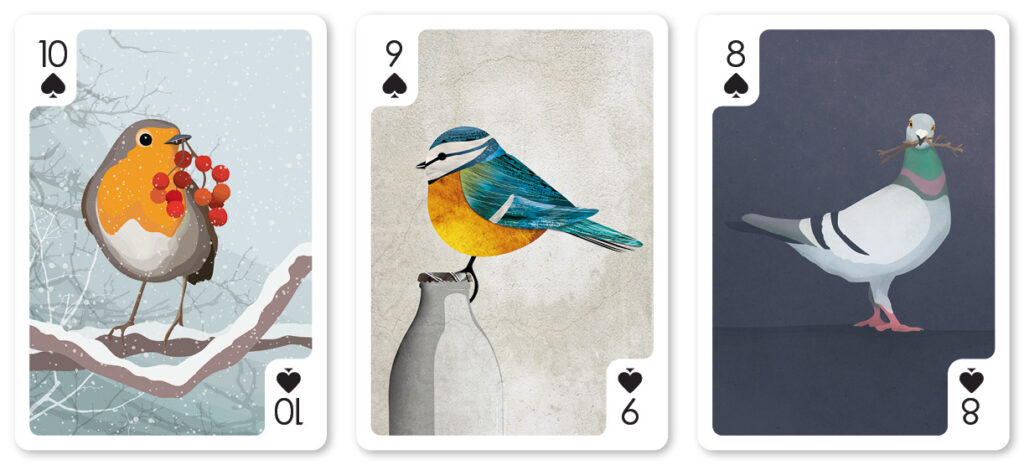
TEN: European robin. Originally called ‘redbreast’, robin was added in the 15th Century as a wee human first name but it stuck. If you’ve ever wondered why it’s not an ‘orangebreast’, believe it or not, English didn’t have a word for orange as a colour until the 16th Century, when the fruit was introduced | NINE: blue tit about to steal milk | EIGHT: pigeon with attitude. Surely the best pigeon thing ever created is Tom Lehrer’s song.

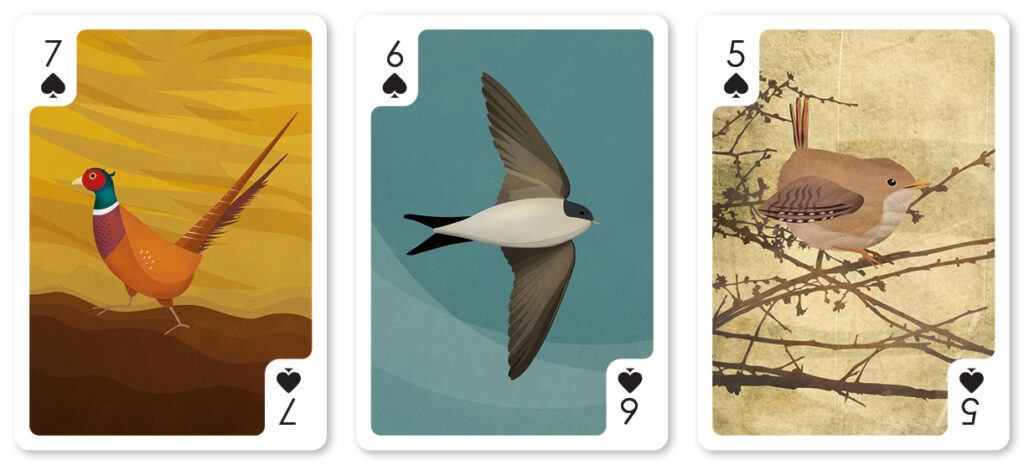
SEVEN: pheasant parading | SIX: house martin – a summer migrant to the UK, preferring the warmer climes of Africa when our weather turns. They can look like swifts in flight, but they’re a bit smaller | FIVE: wren.

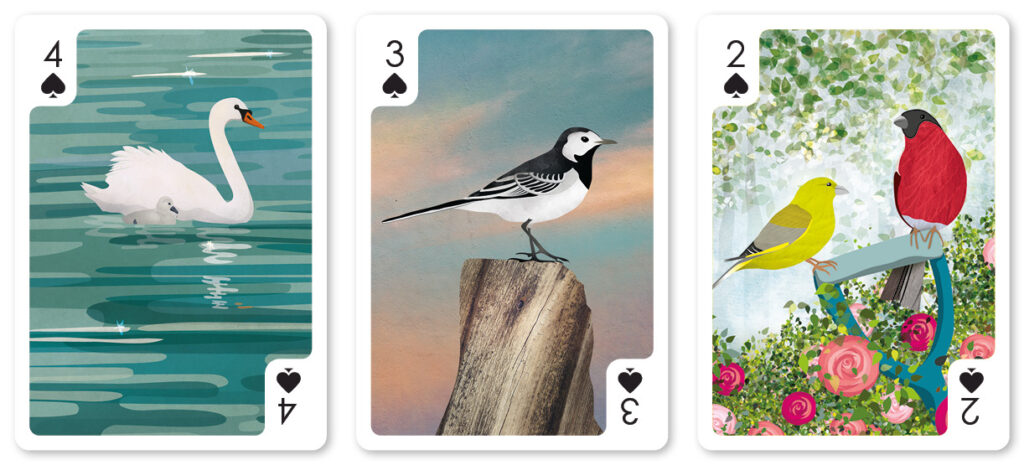
FOUR: swan and cygnet | THREE: wagtail | TWO: greenfinch and bullfinch helping with the gardening.

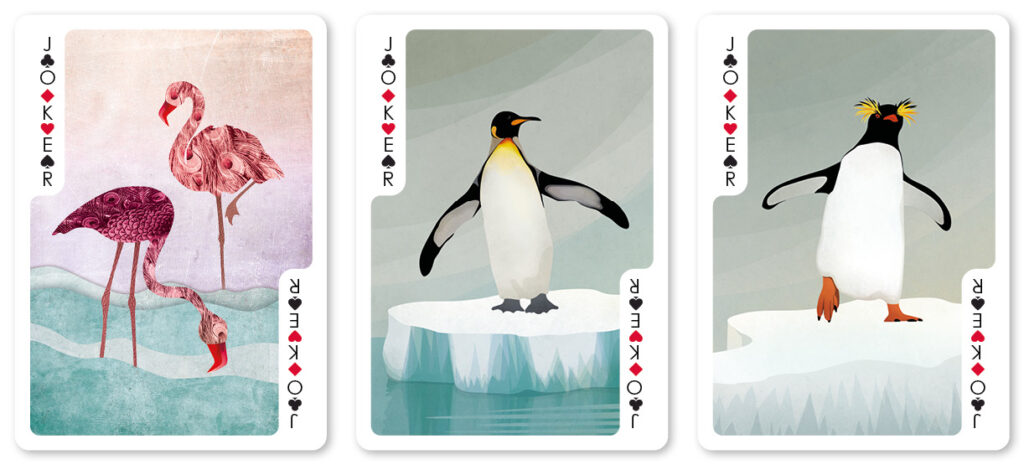
JOKER 1: flamingos – I’ve filled them with peacock feathers, so I don’t have an answer for which species of flamingo | JOKER 2: king penguin – the second biggest penguin species (after the emperor) | JOKER 3: rock hopper penguin – one of the smaller penguins, but surely the best coiffed.
Limited edition prints
Many of my bird illustrations are available as limited edition giclee prints. You can browse them in my shop, but get in touch if there’s one you’d like that I haven’t listed – sometimes I need a nudge!
The cormorant/shag poem
I learned this poem by ear from my friend Cara about 25 years ago, so don’t quote me on it. She’d had it in her head for years by then too, so there’ll be cascading errors in my rendition, but here it is:
The common cormorant, or shag,
lays its eggs inside a paper bag.
The reason you will see, no doubt,
is to keep the lightning out.
But what these unobservant birds,
have failed to notice is that herds,
of wandering bears will come with buns,
and steal the bags to hold the crumbs!
I’ve just googled the poem because it feels wrong not crediting its author! It’s by Christopher Isherwood.. probably.
see brand design | print design | commissioned illustration

